Are Period Panties Suitable for Heavy Flow Days?
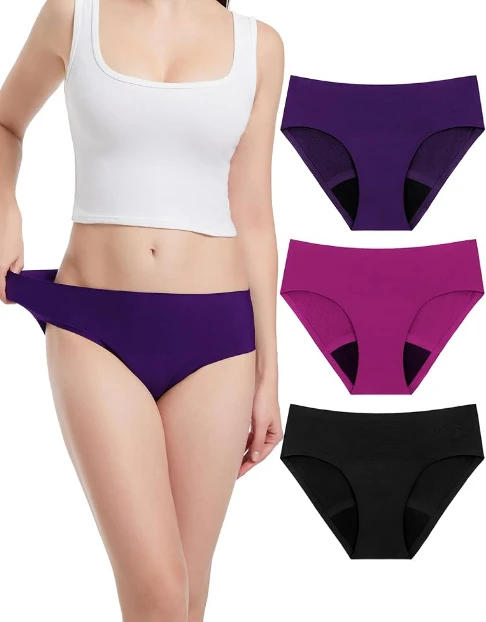
Yes. High-absorbency period underwear can work on heavy-flow days, but performance depends on absorbent capacity, gusset coverage, fit, and how quickly the underwear is changed. The CDC describes heavy menstrual bleeding as including periods lasting more than 7 days, soaking a pad or tampon every hour on the heaviest days, or passing clots larger than a grape. About 1 in 5 U.S. women experience heavy menstrual bleeding. For people near that range, heavy or overnight period panties may work alone for part of the day, while very heavy bleeding may require a fresh pair sooner or an additional menstrual product.
A normal period is not a fixed amount of bleeding. NHS guidance states that periods commonly last 2–7 days, with roughly 20–90 mL of blood lost over the whole period, and bleeding is usually heaviest during the first 2 days. ACOG has also historically used up to 80 mL per cycle as a quantitative reference for normal uterine bleeding, although measuring actual menstrual loss at home is difficult.
That measurement problem matters when choosing period panties. A label such as “heavy,” “super,” or “overnight” is easier to understand than milliliters, but absorbency labels are not a universal medical standard. Two products carrying a heavy-flow label can use different gusset dimensions, fabric layers, construction methods, and testing procedures, so their real wearing time can differ.
Most period underwear uses several functional layers. The layer against the skin moves fluid into an absorbent section, while another layer helps limit leakage into clothing. During lighter bleeding, the amount arriving at the gusset may remain below its absorption rate; during a heavy episode, fluid can arrive faster than it can spread through the fabric.
Capacity and absorption speed are separate issues. A pair may hold a relatively large total volume yet still leak if menstrual fluid reaches one small area faster than the material can distribute it.
This is one reason body position changes performance. Someone sitting at a desk for 8 hours may place fluid in a different part of the gusset than someone walking, running, or sleeping. At night, fluid may move toward the rear of the underwear, making an extended absorbent panel more useful than a short panel concentrated around the center.
Coverage therefore deserves almost as much attention as stated absorbency. For heavy overnight use, look at where the protective material begins and ends rather than judging the product by thickness. Coverage extending toward the rear waistband can provide more usable protection for back sleepers, while broader central coverage may help people who experience leakage near the leg openings.
Fit changes that equation again. A loose leg opening can create a path around the absorbent material before it is saturated, while underwear that is excessively tight can shift or bunch when the wearer moves. The correct size should keep the gusset close to the body without strong pressure, particularly during the first 2 days, when NHS guidance notes that menstrual bleeding tends to be heaviest.
| What to check | Better suited to heavy flow | Less suited to heavy flow |
|---|---|---|
| Absorbency | Heavy, super-heavy, overnight | Light, spotting |
| Rear coverage | Long or waistband-level panel | Short central panel |
| Fit | Close around legs and gusset | Loose, shifting fit |
| Daily use | Spare pair available | One pair expected to last all day |
| Overnight use | Extended front/rear protection | Small absorbent area |
Even a well-fitted pair has a finite capacity, so “all-day protection” should not automatically be read as a fixed 8-, 10-, or 12-hour promise for every wearer. The CDC lists needing a new pad or tampon in less than 2 hours as one sign of heavy menstrual bleeding. Someone bleeding at that level should expect a menstrual product to fill much faster than it would for a person with moderate flow.
A practical first test is to wear a new pair at home during a known heavy day and check it regularly rather than trying to reach the maximum advertised duration. Note when the surface begins to feel persistently wet, when blood approaches the edges of the absorbent zone, and whether leakage appears at the front, back, or leg opening. After 2 or 3 cycles, personal wear time is usually more useful than a generic marketing comparison.
A “four-tampon equivalent” claim should be treated as a product comparison, not a prediction that every wearer will receive four times the wear time of one tampon.
For very heavy flow, period underwear can also be used as secondary protection rather than the only menstrual product. NHS guidance includes needing 2 period products together, such as a pad and tampon, among the signs that periods may be heavy. Someone already using combination protection may find high-coverage underwear useful for catching overflow from a tampon, cup, or disc.
This approach can be useful at work, during travel, or overnight because the underwear provides a second absorbent area if the primary product reaches capacity earlier than expected. It does not increase the safe wearing time of an internal product, however; tampons, cups, and discs still need to be used and changed according to their individual instructions.
Changing the underwear also affects skin comfort. Once the absorbent section is close to saturation, the surface may remain wetter and feel heavier. Staying in a wet pair for hours can increase friction around the groin, especially during walking or exercise. A spare pair and a washable wet bag are therefore more useful for heavy-flow users than relying on one pair from morning until bedtime.
Washing practices matter because reusable underwear is expected to go through many wash cycles. Follow the manufacturer's temperature, detergent, drying, and fabric-softener instructions. If absorbency becomes noticeably poorer after repeated washing, or the waterproof layer begins separating, the pair should no longer be assumed to provide its original level of protection.
Cost also needs to be considered differently from disposable pads or tampons. Reusable underwear requires a larger initial purchase, but the same garment can be worn repeatedly when properly cared for. A person who needs 2 pairs on a heavy day will also need enough clean, fully dry pairs to cover the wash-and-dry interval, so buying one high-absorbency pair rarely supports full-time use across several heavy days.
A small rotation is easier to evaluate before buying more:
-
Start with 1–2 high-absorbency pairs and test them during the heaviest part of the cycle.
-
Record approximate wear time over 2–3 periods rather than relying only on the package claim.
-
Check the front, rear, and leg openings after use to see where fluid is collecting.
-
Keep at least 1 spare pair available when bathroom access or travel time is uncertain.
-
Use additional menstrual protection when the underwear repeatedly reaches capacity sooner than expected.
Product performance is only one part of the issue because unusually heavy bleeding can require medical assessment. CDC data state that heavy menstrual bleeding affects more than 10 million American women each year, or about 1 in 5 women. Warning signs include bleeding for more than 7 days, soaking through protection every hour for several hours, passing quarter-sized or larger clots, or feeling tired, weak, or short of breath.
Heavy bleeding can contribute to anemia, and sometimes it is associated with an underlying bleeding disorder. ACOG reports that bleeding disorders are found in about 20% of adolescent girls evaluated for heavy menstrual bleeding and approximately 33% of adolescent girls hospitalized for it. Evaluation may include checking for anemia, including serum ferritin, along with possible endocrine or bleeding disorders.
Von Willebrand disease is one example. ACOG reports an estimated prevalence of 0.6–1.3% among American women, while published prevalence among women with chronic heavy menstrual bleeding has ranged from 5% to 24%. Period underwear can manage menstrual fluid from such bleeding, but it cannot identify or treat the medical reason for the increased blood loss.
For everyday product choice, the useful question is therefore not whether period underwear works for “heavy flow” as one broad category. Compare the pair's absorbency level, protected area, fit, expected changing opportunities, and performance during your own heaviest hours. Heavy or overnight period panties can be worn alone when their capacity matches the flow; faster saturation calls for earlier changes or additional protection.
If bleeding repeatedly soaks through menstrual protection every 1–2 hours, lasts longer than 7 days, causes large clots, or comes with unusual tiredness or shortness of breath, product capacity is no longer the only consideration. CDC and NHS guidance both recommend medical evaluation for patterns consistent with heavy menstrual bleeding, particularly when they interfere with normal daily activities.