Free Design Versus a Paid Kitchen Designer
A paid kitchen designer sells time, drawings and a name on the line. CasaBuilt's free service charges for none of those things: it returns a 3D cabinet layout in 24-48 hours at no charge, and it stops at the cabinet line. The difference is easier to see in money than in philosophy, because the cabinet order is the same size either way. An $18,000 cabinetry budget carries $2,700 to $4,500 of trade-band savings at the published 15-25% rate, which is the scale any design fee has to justify.
Key takeaways
- The free service returns a 3D cabinet design in 24-48 hours and stops at cabinets, not countertops or wiring.
- A paid designer is paid for time and carries the layout risk in a way a free drawing does not.
- Trade pricing is published at 15-25% off retail, worth $2,700 to $4,500 on an $18,000 cabinet budget.
- The warranty covers manufacturing defects for one year; it does not cover a layout that was wrong from the start.
What a paid designer is actually selling
When someone charges for a kitchen design, the invoice usually covers three things that are easy to bundle and hard to separate. The first is time: site visits, revisions, calls with the contractor and the hours spent turning a wish list into a buildable plan. The second is a set of drawings that other trades can work from, which is a different deliverable from a picture of cabinets. The third is accountability, in the sense that the person who drew it is the person you call when a wall does not measure what the plan said.
None of that is a criticism of the free route. It is a description of the trade. A free cabinet layout is priced into the cabinet sale, so the incentive sits on the order rather than on the drawing. A paid designer's incentive sits on the drawing, which is why the same room can produce two very different documents at two very different price points.
The question is not which is better. It is which risk you are carrying at each stage, and whether you are paying someone else to carry it.
What the free service covers, precisely
CasaBuilt publishes a free expert 3D kitchen design delivered in 24-48 hours, and a trade version that covers a kitchen and other rooms in less than 72 hours. The output is a rendered layout of standard cabinet boxes, priced from the published catalog. The boxes are fixed sizes: bases at 34-1/2 inches high and 24 inches deep, walls at 12 inches deep in 30, 36 or 42-inch heights, vanities at 21 inches deep.
That scope is wide enough to answer the questions most people actually have. Will a 36-inch pantry fit beside the fridge, does the run end in a filler, do 42-inch wall cabinets make the room feel taller or crowded. It is not wide enough to answer questions about countertop overhang, under-cabinet lighting circuits, or whether the floor needs leveling before the boxes go down.
Read the free offer as a drawing of the order, and the comparison with a paid designer becomes fair. You are comparing a cabinet layout against a kitchen plan, not two versions of the same service.
The line items, side by side
Published figures make the cost side concrete, even though no design fee is published anywhere on the CasaBuilt site. What is published is the price of the cabinets, the sample and the freight threshold, which is where most of the money in a kitchen actually sits.
| Line item | Published figure | What it changes |
|---|---|---|
| 3D kitchen design, homeowner | No charge, 24-48 hours | Nothing on the invoice |
| Kitchen and room design, trade | No charge, under 72 hours | Nothing on the invoice |
| Door sample | $9.99, refundable with a purchase | Small, refundable deposit |
| Basic kitchen, White Shaker | $1,199.50 (list $2,399.00) | The product itself |
| Basic kitchen, Slim White Oak | $2,295.64 (list $2,869.56) | Finish upgrade on the same six boxes |
| Free freight threshold | $2,500 and above | Whether delivery is billed |
Two things jump out of that list. The first is that the design is genuinely free at the point of use, with no deposit and no design fee netted against the order. The second is that the freight threshold sits just above the cheapest starter kitchen, so a small order pays delivery while a larger one does not.
A paid designer's fee would sit on top of these numbers, not inside them. That is the honest way to compare: cabinet cost plus design cost, on one line, rather than a free drawing against a fee that includes a different scope.
Accountability is the part you cannot see in a price
Ask any designer, free or paid, three questions before work starts. What happens if a measurement is wrong and a cabinet does not fit? How many revisions are included? Who owns the drawing when the project ends?
The cabinets free design route is a service attached to a product sale, so any remedy runs through the order. A paid designer is usually engaged under a contract that says what happens when the drawing is wrong, because that is what the fee buys. On this route the remedy is a replacement part or a solution for a manufacturing defect, covered for one year under the published warranty. That warranty covers materials and workmanship under normal residential use. It does not turn a layout mistake into a free cabinet.
This is not a reason to avoid the free route. It is a reason to bring your own measurements and to check the drawing against them before you order. The buyer who measures carefully gets the best of both models: a two-day drawing at no charge and a cabinet order that fits.
Worked example
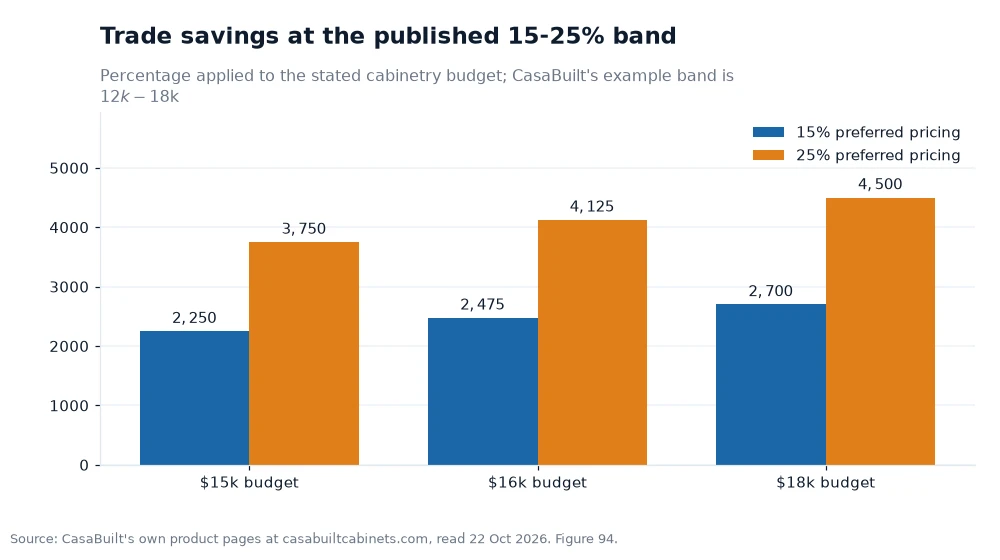
The chart plots the published trade band at three budgets, with 15% savings in the first series and 25% in the second. The values are $2,250, $2,475 and $2,700 at 15%, and $3,750, $4,125 and $4,500 at 25%. Divide each 15% bar by 0.15 to recover the budget it was calculated on: $2,250 divided by 0.15 is $15,000, $2,475 divided by 0.15 is $16,500, and $2,700 divided by 0.15 is $18,000. Divide the 25% bars the same way and the budgets come back as $15,000, $16,500 and $18,000, identical to the first series.
That gives the middle bar a useful correction: it reconciles to a $16,500 budget, not $16,000, so read it as the middle of the band rather than a precise $16k figure. The arithmetic is consistent within each series, which is what matters when you use the chart to size a job.
Now test the range on an $18,000 cabinetry budget. At 15% the saving is $2,700, and at 25% it is $4,500. The spread between the two ends is $1,800, which is 10% of the budget and more than the $1,199.50 price of a White Shaker starter kitchen. Put another way, the difference between the low and high end of the trade band buys one and a half starter kitchens.
Compare that with the design fee question. If a paid design costs a flat amount, the trade saving on an $18,000 order covers it or does not, and you can see which before you commit. On a $15,000 order the band is $2,250 to $3,750, a spread of $1,500, so the same test applies at a smaller scale.
Frequently asked questions
Is a free design as thorough as a paid one?
No, and it is not meant to be. The free service produces a 3D cabinet layout from standard box sizes and returns it in 24-48 hours. A paid designer typically adds site visits, construction drawings and coordination with other trades. Compare the deliverables, not the labels, and decide whether you need the extra documents.
Do I need the trade program to get a discount?
The trade program publishes 15-25% preferred pricing against standard retail and is aimed at contractors and trade buyers. The retail sale prices on each style page, such as $1,199.50 for the White Shaker starter kitchen against a $2,399.00 list, are separate from that band. Ask which price applies to your order before you compare quotes.
Who is responsible if the layout is wrong?
The buyer supplies the measurements, so the buyer confirms them before ordering. CasaBuilt covers manufacturing defects in materials and workmanship for one year, which is a product remedy rather than design insurance. If a layout error would be expensive to fix, that is the argument for a paid designer or a second check of every dimension.
Decide what you are buying before you compare prices
Write down what you need from the design: a picture to approve, a cabinet list to price, or drawings another trade can build from. If it is the first two, the free route covers the job and the only cost is your measuring time. If it is the third, pay for the documents and treat the cabinet order as a separate purchase.
Either way, get the cabinet list in writing and check it against a tape measure. The drawing is the sales argument; the list is what arrives on the truck. Contractors who order repeatedly can look at the trade partner program for the pricing band and the quick-ship terms before the first order.
Figures quoted here come from the manufacturer's own website, read 22 Oct 2026[1].