What Changed in Home Fragrance Cost Structures Lately
The biggest change in home fragrance costing over the past few years is not the price of fragrance oil. It is that more of the cost has moved out of the product and into the obligations around it: what the packaging is made of, what has to be documented, how small a run can be, and how quickly a trend has to be answered. Brands that still model cost as oil plus glass plus labour keep finding that the total does not match the invoice.
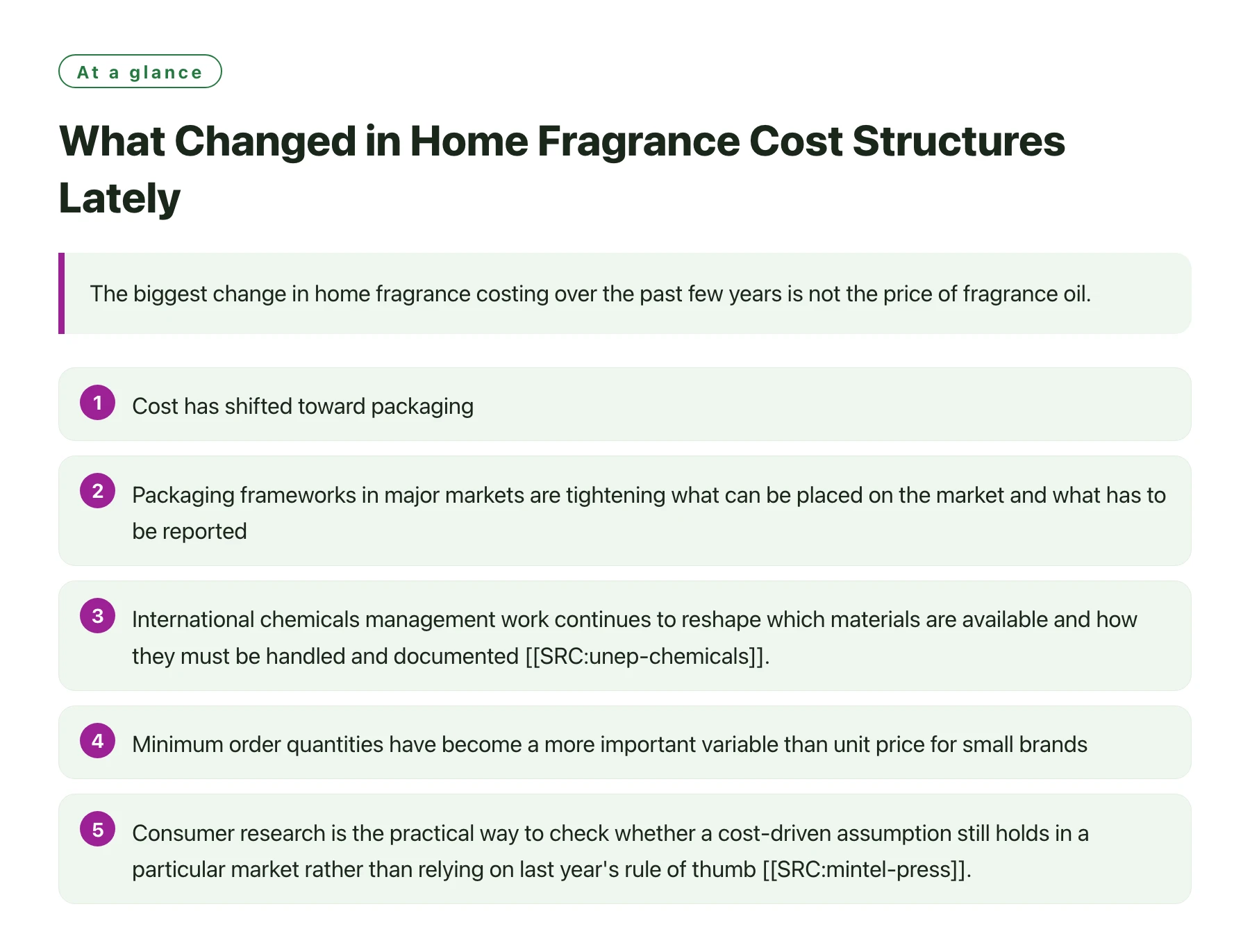
Key takeaways
- Cost has shifted toward packaging, documentation and compliance work, which are harder to renegotiate than material prices.
- Packaging frameworks in major markets are tightening what can be placed on the market and what has to be reported, which changes material choices at the design stage [1].
- International chemicals management work continues to reshape which materials are available and how they must be handled and documented [2].
- Minimum order quantities have become a more important variable than unit price for small brands, because cash tied up in inventory is a cost that never appears on a quote.
- Consumer research is the practical way to check whether a cost-driven assumption still holds in a particular market rather than relying on last year's rule of thumb [3].
Anyone who costed a home fragrance line five years ago and is costing one now will recognise the product but not the spreadsheet. The development side has not changed much: a brief, an oil, a substrate, a vessel, a carton. What has changed is how many of those lines now carry a compliance or reporting obligation, and how much flexibility remains in each of them.
These are the shifts that come up most often in sourcing conversations, and what each one means for a brand's cost model.
Packaging stopped being a purely aesthetic decision
Packaging used to be priced almost entirely on material, decoration and volume. Now it also has to be assessed against what the destination market will accept. The European Union's work on packaging and packaging waste has moved obligations upstream, which means the material mix, the recyclability of a component and the reporting behind it enter the decision before the design is finalised [1].
In practice this adds two cost lines. The first is engineering: a refillable or mono-material structure usually costs more per unit than the simplest alternative and may need tooling. The second is administrative: somebody has to establish what applies to the product, keep the evidence and update it when the rules move. Neither is large on its own, and together they are large enough to change which pack format is viable.
Refill formats moved from premium to practical
Refills were once a niche premium gesture. As packaging obligations tighten, they become a way to keep a branded vessel in use while reducing the material in the repeat purchase. That changes the cost model: the first purchase carries the vessel, every repeat purchase does not, so the margin profile of a customer differs from the margin profile of a unit.
Decoration choices narrowed
Complex decoration and mixed materials make recycling harder and documentation longer. The result is a slow move toward fewer materials per pack, simpler decoration and clearer separation of components — cheaper to document, sometimes more expensive to make look premium. That trade-off matters most to the brands described in the rise of niche perfume brands, which compete on presentation and therefore feel every simplification in the pack.
Rebuild the cost model once a year. Take last year's sheet and ask which lines are now regulated, which materials have substitutes, and what the minimum order actually is. Most of the drift in home fragrance margin happens in that gap, quietly, between one annual review and the next.
Where the pressure has moved
| Cost line | Direction of pressure | Why it moved | What a buyer can do |
|---|---|---|---|
| Fragrance oil | Volatile, driven by material availability | Regulatory restrictions and harvest variability on natural materials | Fix the dosage target early and keep one alternative accord approved |
| Packaging material and structure | Upward, especially for mixed materials | Recyclability and reporting obligations entering the design stage | Design for fewer materials and price two structures before choosing |
| Documentation and testing | Upward | More evidence required per market and per product form | Ask which documents are reusable across markets |
| Minimum order quantity | Tighter for small brands | Setup costs spread over fewer units | Plan fewer sizes and buy depth in one |
| Freight and inventory | Less predictable | Longer supply chains and larger safety stock | Cost the cash tied up in stock, not only the unit price |
The pattern in the middle column is the important one: the lines that moved are mostly the ones a brand cannot negotiate down, only design around.
Materials: fewer substitutions, more paperwork
International work on the sound management of chemicals has been steadily reshaping which materials are available, how they can be handled and what has to be documented when they cross a border [2]. For a home fragrance brand this rarely appears as a dramatic reformulation. It appears as a supplier writing to say a material has been restricted in a category, that a substitute is proposed, and that the change needs re-approval.
Each of those notes has a cost: a new sample, a new evaluation, sometimes a new safety document. Brands that keep a second approved accord and a documented dosage for each product absorb that far more cheaply than brands that approve one formula and treat it as permanent.
The approval file is now a cost asset
A well-kept specification file — category, dosage, substrate, test records, approved references — is what makes a substitution cheap. Without it, every material change restarts the project. That is one reason manufacturers keep specifications on their side, and it is a reasonable question to ask when comparing suppliers. For a brand that is not yet ready to own and maintain that file, the alternative route is private label fragrance production, where the development record stays with the manufacturer and the brand buys a finished format instead.
Trend speed costs more than it looks
The expectation of a faster trend cycle has not gone away. It shows up as pressure to run smaller batches more often, which raises setup cost per unit and increases the number of approvals per year. Brands that want speed should budget for it in the development line, not in the oil line.
How this changes the sourcing decision
When cost moves from materials to obligations, the supplier's process becomes part of the price. A factory that can document what it did, reuse test evidence across markets and handle a substitution without restarting the project is cheaper over a product's life even when its unit price is slightly higher. That is a different comparison from the one most brands run.
It also changes how much of the range is worth owning. The shift toward refills, fewer materials and tighter documentation rewards brands that run a narrow line well, and it penalises wide ranges built by scaling one successful product into six sizes. The market position that rewards this is the one custom development is designed for: a scent and a format that are specific to the brand rather than generic, which is the case Xuelei custom perfume is built around.
None of this is an argument for standing still. It is an argument for costing the obligations on purpose, so that the price a brand quotes to a retailer is based on the product it will actually ship. The broader shift toward independent brands is itself part of the demand picture that market researchers keep revisiting [3], and it shows up in cost models as smaller, more frequent orders.
Ask for the cost of a change, not just a price
A useful question in any supplier conversation is what a material substitution or a carton change would cost in money and time. Suppliers who can answer it have the file in order; suppliers who cannot are telling you something about how the next change will go.
Keep two cost models
One at today's prices, one at a plausible worst case for the two inputs that move most: the oil load and the pack structure. If the product only works in the first model, the range is more fragile than the margin suggests.
Sources
- European Commission: Packaging Waste and the PPWR —— EU rules on packaging and packaging waste, including the Packaging and Packaging Waste Regulation requirements on recyclability and design.
- UNEP: Chemicals and Pollution Action —— The UN Environment Programme's pages on chemicals management, including the sound management of chemicals in products.
- Mintel Press Centre —— Mintel's press releases on consumer and beauty market research, including fragrance and personal care trend reporting.
Frequently asked questions
Has home fragrance unit cost actually increased?
It depends on the specification. Material prices move both ways, while documentation, testing and packaging obligations have generally added cost and complexity. The reliable comparison is a rebuilt specification sheet priced today against the same sheet priced two years ago.
Why does a smaller order now cost so much more per unit?
Because setup work — development, artwork separation, tooling, printing, line changeover and testing — does not shrink with the quantity. As compliance work per product has grown, that fixed cost has grown with it.
Are refill formats cheaper for the brand?
Not necessarily on the first purchase, because the vessel and the refill system both cost money. They shift margin toward repeat purchases and reduce packaging material per use, which is where the benefit shows up.
How often should a home fragrance cost model be updated?
At least annually, and immediately after any material substitution, packaging change or new destination market. Those three events are what invalidate a costing sheet fastest.
Does this affect small brands more than large ones?
It affects them differently. Small brands feel minimum order quantities and fixed documentation costs more acutely; large brands feel packaging obligations and substitution paperwork across a much wider range of products.